
Guide
CRM examples: how small businesses use a CRM
These CRM software examples include Salesforce, HubSpot, Pipedrive, Zoho CRM, Less Annoying CRM, and honestcrm. A CRM stores your contacts, companies, and deals, and keeps the history of every conversation in one place. Five uses follow, then an example of each CRM type. honestcrm is a CRM for small business, and each of these products runs as a cloud-based CRM in your browser.
Five examples of how businesses use a CRM
Marketing or design agency
An agency tracks each prospect from first inquiry to signed proposal, then keeps the client record for renewals. The CRM holds the proposal deal, the decision maker, and the notes from each call. A reminder task prompts you to follow up on each open proposal.
Independent insurance agent
An agent keeps each client and the policies they hold, with the renewal date on a task. The CRM shows which renewals fall due this month and which clients have not been contacted lately. Notes record household details that matter at renewal.
Construction firm
A builder tracks each bid as a deal, with the estimator, the client, and the architect linked to it. The pipeline shows which bids are out and which are waiting on a decision. Follow-up tasks flag bids with no recent contact.
Consultant
A solo consultant keeps a list of past clients, referrers, and prospects. A note after each conversation records what was discussed, and a task sets the next check-in. Over time the list shows where work comes from.
Startup
A small founding team tracks early customers, pilots, and investors in one shared pipeline. Everyone sees who spoke to whom, so two people do not email the same lead. The team adds fields as the sales process takes shape.
The pattern is the same in each case. Every person and company has one record, every deal sits in a sales pipeline, and every follow-up has a task with a date.
Examples of the three types of CRM
CRM systems are usually grouped into three types. The descriptions below follow the Wikipedia article on customer relationship management. Most products combine more than one type, and vendors rarely label themselves by type.
- Operational CRM
- Integrates and automates sales, marketing, and customer support. Example: a pipeline where each deal moves through stages and creates follow-up tasks.
- Analytical CRM
- Analyzes customer data from many sources to support decisions. Example: a report of won deals by lead source. See the CRM dashboard guide for how your team reads these numbers.
- Collaborative CRM
- Shares customer information across teams and with outside parties such as suppliers and distributors. Example: a shared timeline where sales and support both see the same history. In honestcrm, every user on the plan sees the same contact timeline.
Operational CRM in practice
An operational CRM handles the daily work of selling and serving customers. A new inquiry becomes a contact and a deal. The deal moves through pipeline stages, and each stage can create a follow-up task with a due date. Email, calls, and notes attach to the contact, so the next person sees what happened. Most small businesses start here, because this is the work that a spreadsheet handles badly once more than one person is involved.
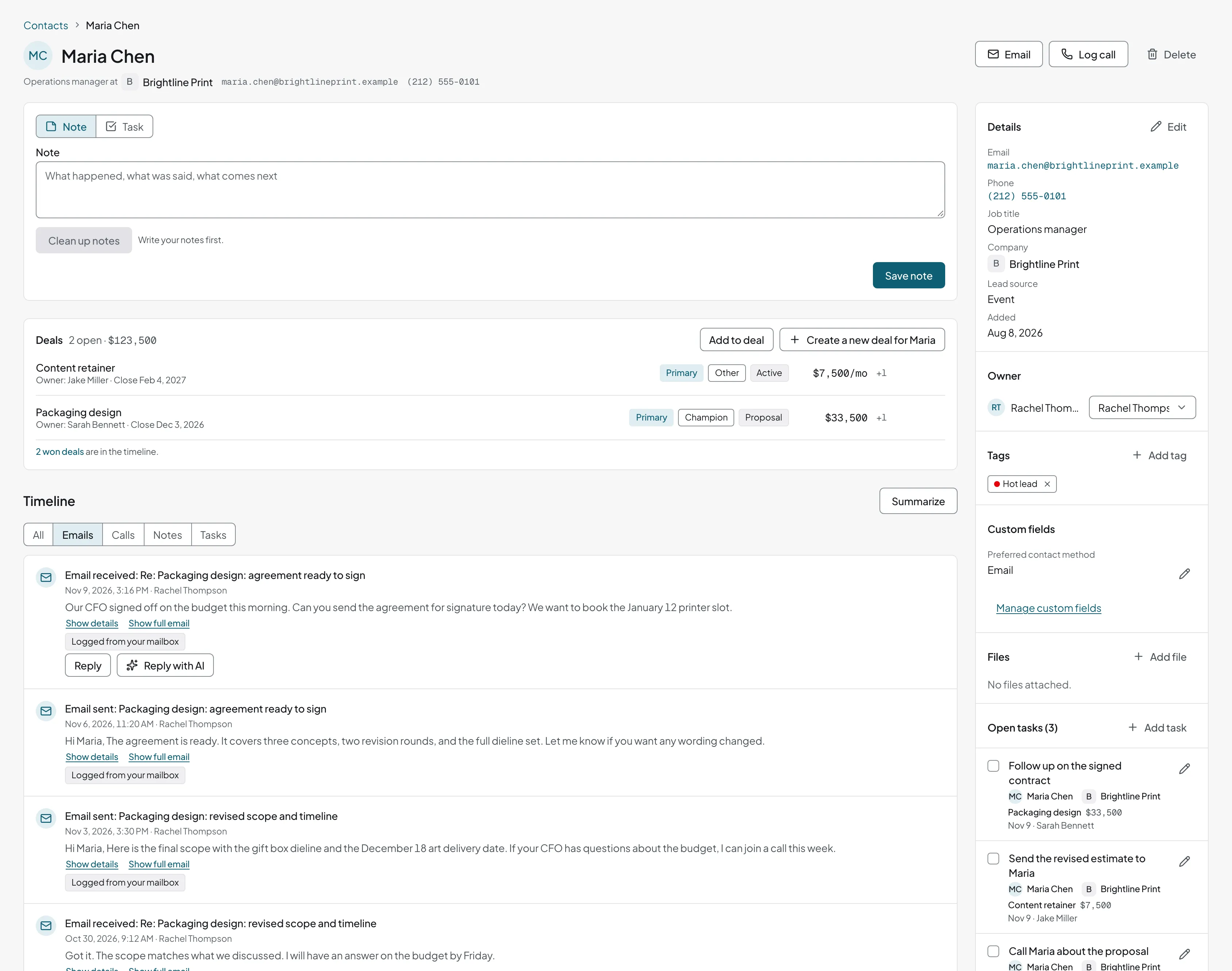
An example record in honestcrm
A contact record holds the person's details, their company, any open deals, and a timeline of emails, calls, notes, and tasks. You can add custom fields and tags, and you can import records from CSV or Excel files, or from Google Sheets. Read about contact management, customer databases, and the full feature list. See pricing for the plans.
Related guides
- Cloud-based CRM
How these examples differ from on-premise software.
- CRM database
The records behind each example.
- CRM cost calculator
See what the examples you like would cost your team.
CRM examples questions
What is an example of a CRM?
A CRM is software such as Salesforce, HubSpot, Pipedrive, Zoho CRM, Less Annoying CRM, or honestcrm. Each stores contacts, companies, deals, and the history of your communication with them.
What are the three types of CRM?
The three commonly described types are operational, analytical, and collaborative. Operational CRM automates sales, marketing, and service tasks. Analytical CRM analyzes customer data. Collaborative CRM shares customer information across teams and with outside partners.
Which type of CRM does a small business need?
Most small businesses start with operational features: contacts, a deal pipeline, tasks, and email history. Reporting and shared access come with the same tool. Choose by the work you do each day, not by the type label.
Is a spreadsheet a CRM?
A spreadsheet can store a contact list, but it does not link emails, tasks, and deals to each contact. Many teams start with one and move when the list becomes hard to share. See the guide to a CRM database for the differences.