
Sales pipeline
How to build a sales pipeline that shows what to do next
A sales pipeline is the list of your open deals, grouped by the stage each one has reached. Each stage answers one question about the deal, and a deal moves on only when the answer is yes. Read three numbers each week to see where deals stall. honestcrm runs the pipeline as a board, free for your whole team.
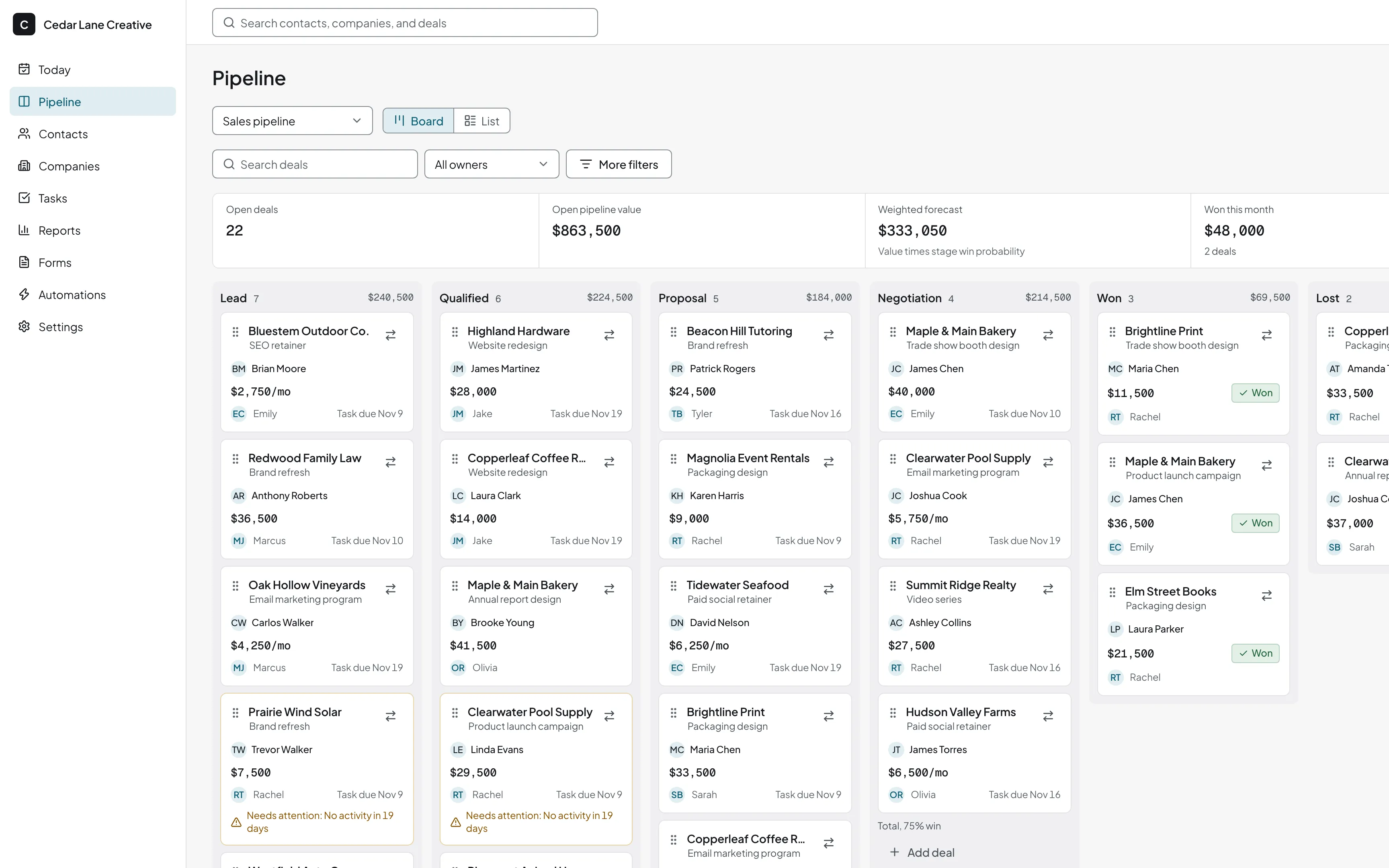
Sales pipeline vs sales funnel
A sales pipeline
Tracks each deal by name. You see that Acme is at Proposal, worth $8,000, with a follow-up due Thursday. It answers "what do I do next?"
A sales funnel
Counts how many prospects reach each step. You see that 40 became leads and 4 became customers. It answers "where do we lose people?"
They share one set of stages. Build the pipeline first, and the funnel numbers come from the stage history.
How to design your pipeline stages
List what the buyer does
Replies, takes a call, receives an offer, asks for changes, signs. Those are your stages.
Keep four to six open stages
Fewer stages get updated. Merge two steps if deals never wait between them.
Write one exit rule per stage
A sentence that says when a deal may move on, with proof you can point to.
Pipeline stage templates by industry
The steps change with the business. The shape stays: a first contact, a check that the buyer is real, an offer, and a decision. These are built-in templates, and you can rename every stage.
- 1
Lead
- 2
Qualified
- 3
Proposal sent
- 4
Negotiation
- 1
Lead
- 2
Quote requested
- 3
Quote sent
- 4
Application
- 1
Inquiry
- 2
Pre-qualified
- 3
Application
- 4
Underwriting
- 1
Request for quote
- 2
Quoted
- 3
Samples
- 4
Negotiation
Built for one of these trades? See the pages for agencies and insurance.
Stage exit criteria: when a deal may move on
An exit rule is the test for leaving a stage. Without one, each person decides alone and the totals stop meaning anything. Here is a sample for the generic pipeline above. Change the wording to fit what you sell.
| Stage | A deal leaves when | Proof on the record |
|---|---|---|
| Lead | Someone with a real need has replied, or asked for something. | A reply, a form entry, or a referral note on the contact |
| Qualified | You know the need, the budget range, who decides, and when they want it. | Four answers written in the deal notes |
| Proposal | A written offer with a price is in their hands. | The email with the offer, logged on the deal |
| Negotiation | They answered the offer and are asking for changes. | Their reply, logged, and a task for your next move |
| Won or Lost | A yes, a no, or 60 days of silence after two follow-ups. | A won or lost reason picked from your list |
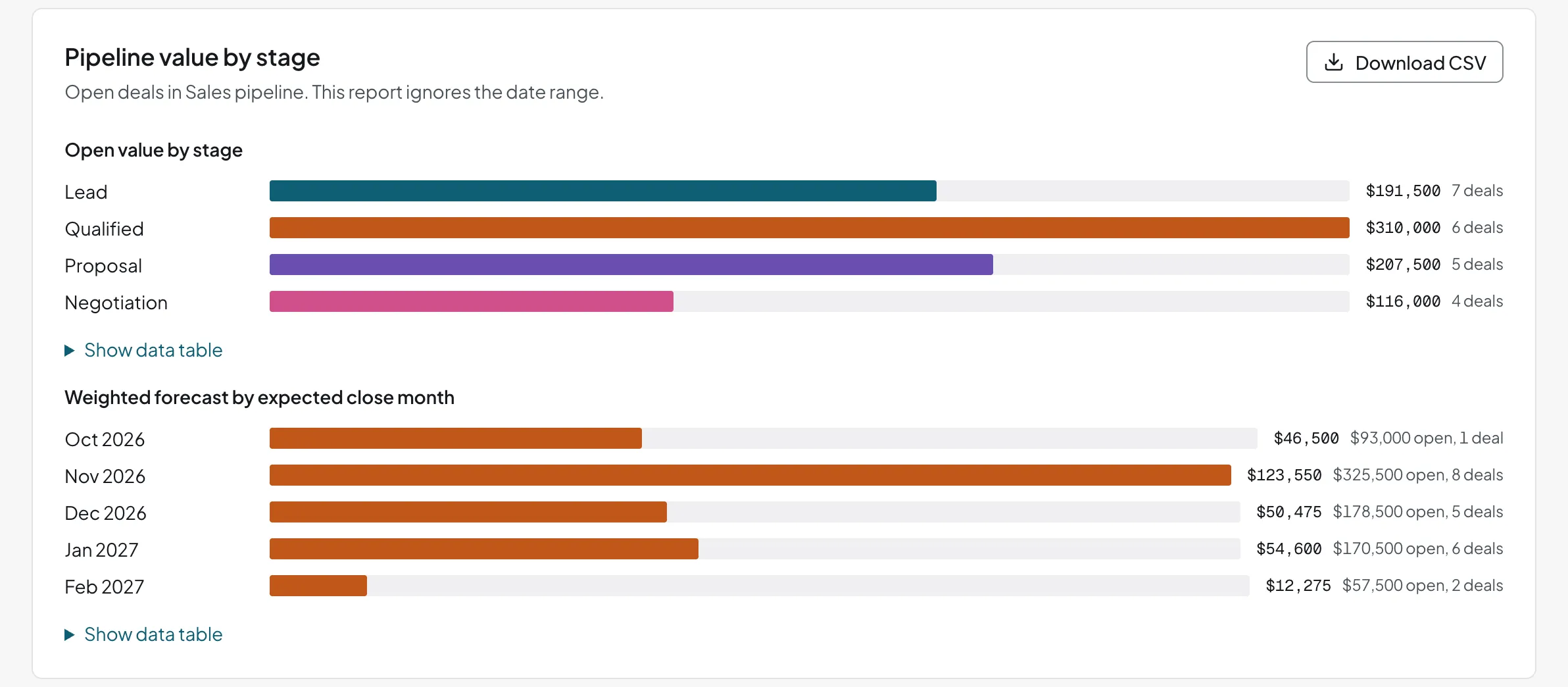
Three pipeline metrics, with the formulas
You need a few numbers, read the same way each week. The figures are examples that show the arithmetic. They are not benchmarks.
| Metric | Formula | Example input | Example result |
|---|---|---|---|
| Pipeline coverage | Open pipeline value divided by the target for the period | $150,000 open, $50,000 target | 3 to 1. Many teams start from 3 to 1 and then adjust it using their own win rate. |
| Stage conversion | Deals that moved to the next stage divided by deals that entered this one | 40 leads, 20 qualified, 10 proposals, 4 won | 50% lead to qualified, 50% qualified to proposal, 40% proposal to won. Fix the weakest step first. |
| Cycle length | Average days from deal created to deal won | Three won deals took 30, 45, and 60 days | 45 days. A deal open for 120 days is not behaving like your usual deal. |
Add win rate (deals won divided by deals closed) and the reasons you lose. They are on the CRM dashboard page.
Six sales pipeline mistakes
- Stages named after your own actions
- "Sent follow-up" is your action. "Proposal viewed" is theirs. Name stages after buyer progress, so a stage tells you where the buyer stands.
- Too many stages
- Past 6 or 7 open stages, people skip some or move deals in batches on Friday. Four to six open stages is enough for most teams.
- No exit rule
- If two people read "Qualified" two ways, the pipeline total means nothing. Write one sentence for each stage.
- Deals that never close
- An old deal inflates the pipeline and every ratio built from it. Close it as lost with a reason, and reopen it if the buyer returns.
- One pipeline for everything
- New customers and renewals have different steps and different cycle lengths. Give each its own pipeline.
- Missing value or close date
- Coverage and forecast need both. A deal without them is a contact, not a pipeline entry.
How honestcrm runs your pipeline
- A board of deals by stage, with drag and drop
- Unlimited pipelines, each with stages you name and order
- Built-in templates for agency, consulting, insurance, mortgage, manufacturing, and construction
- Value, expected close date, owner, and a won or lost reason on every deal
- Email and notes on the deal's contact, so the history sits next to the stage
- Pipeline value, forecast, win rate, and team activity reports
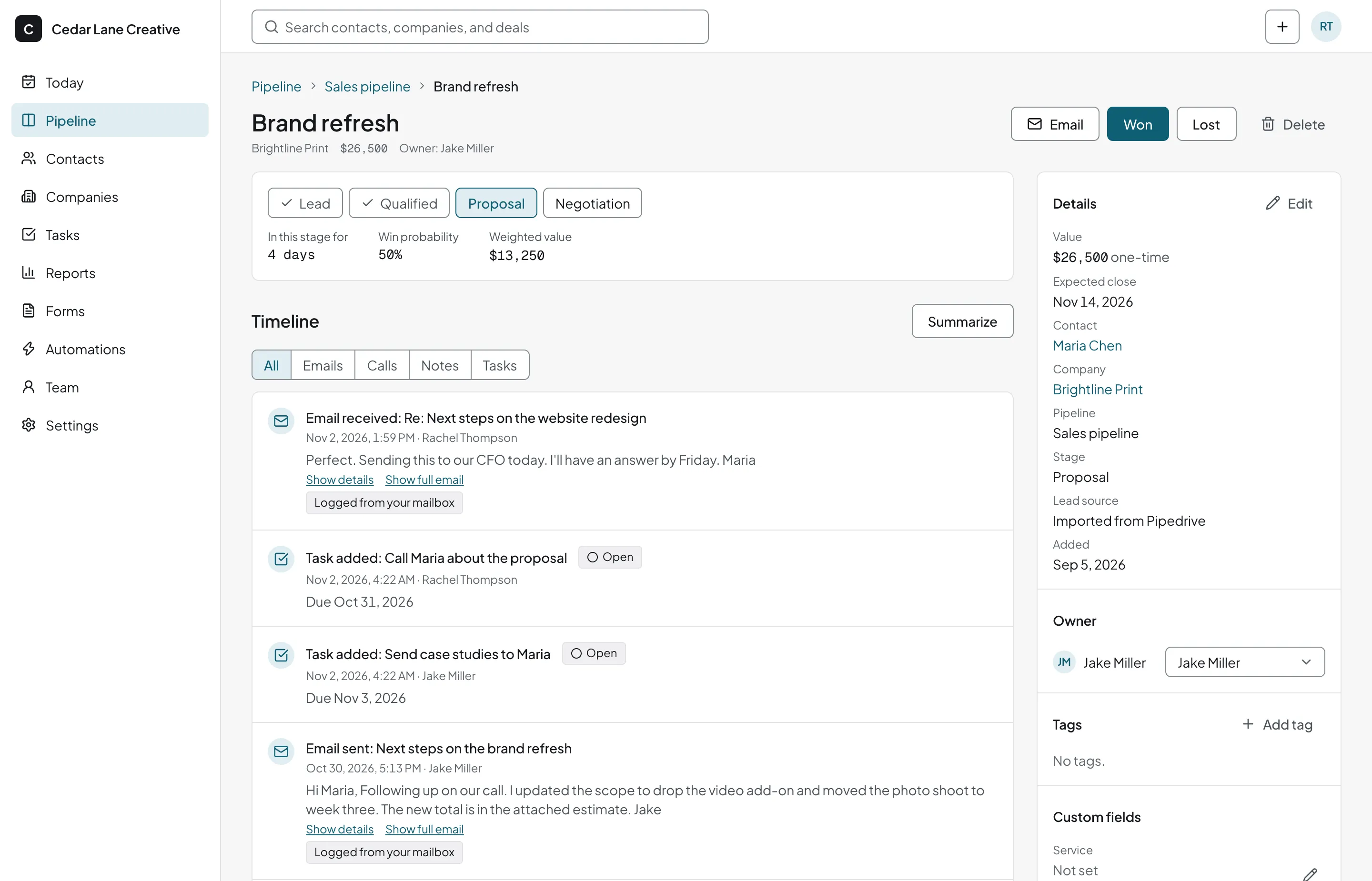
Open any deal to see where it stands. The stage, win probability, and weighted value sit above the history of emails and tasks.
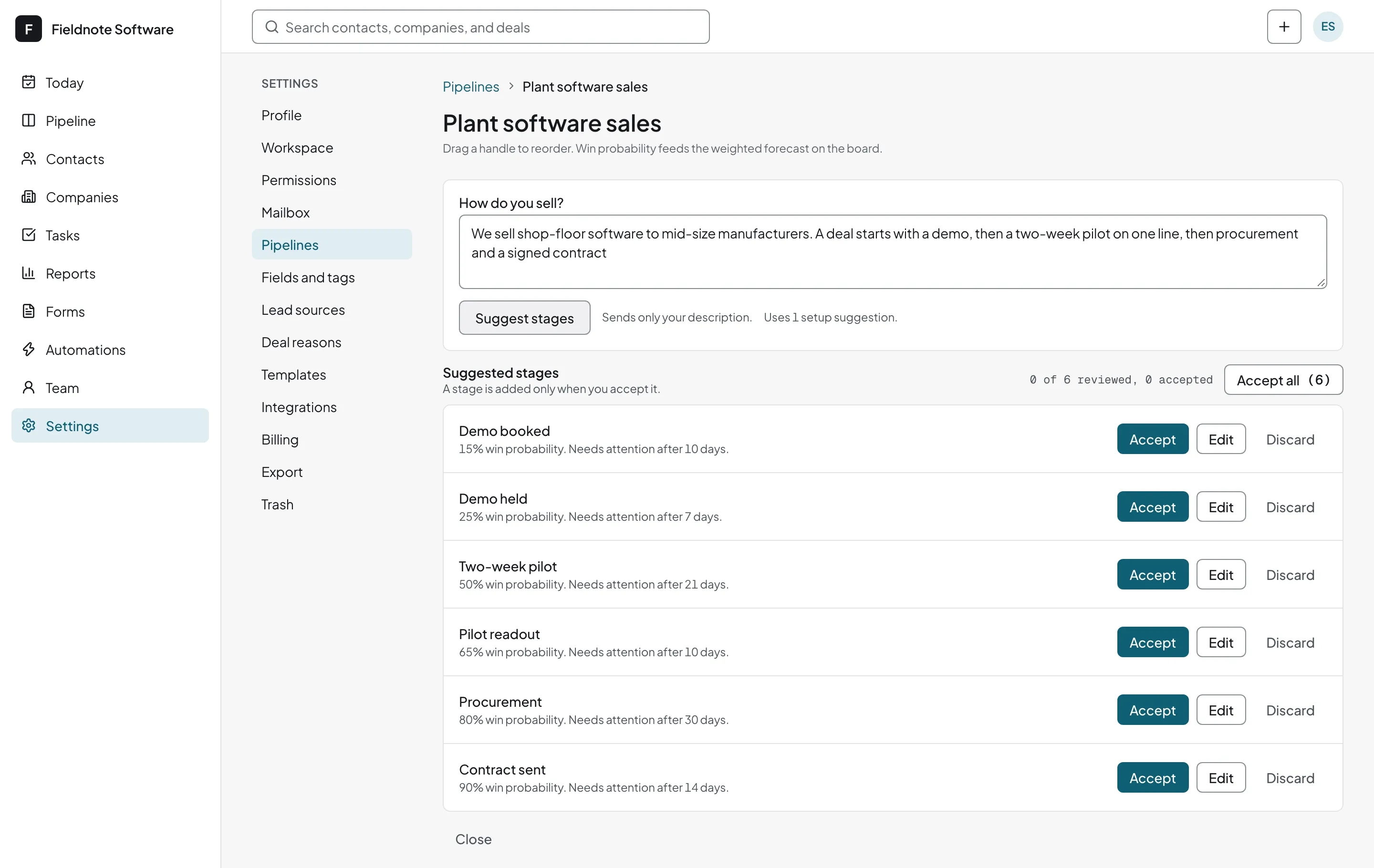
Describe your process, get stages
To get started, type a sentence about how you sell, and the app suggests up to 8 stages. You edit them before anything is saved. It runs only when you click.
Moving a pipeline over
If you keep a pipeline in a sheet, upload it as CSV, Excel, or Google Sheets and check the column mapping. See the sales tracker page for the steps and a free template. Coming from Pipedrive, HubSpot, or Less Annoying CRM? Import presets bring deals and notes. The people on your deals live in contact management. Adding teammates costs nothing extra, which the pricing page lays out. See every feature on the features page.
Sales pipeline questions
How do I develop a sales pipeline?
Write down the steps a buyer takes from first contact to signing. Name each step after something the buyer did, and write one sentence for when a deal may leave it. Keep four to six open stages, add Won and Lost at the end, then move your current deals onto the board. Change the stages after a month if deals pile up in one place.
What is the difference between a sales pipeline and a sales funnel?
A sales pipeline tracks individual deals as they move through your stages, so you can see what to do next on each one. A sales funnel describes the share of prospects that survive each step, so you can see where you lose people. The same stage data feeds both.
What is another term for sales pipeline?
People also say deal flow, sales funnel, or sales process. A pipeline is the list of open deals by stage. The sales process is the set of steps behind it.
How many stages should a sales pipeline have?
Four to six open stages for most teams, plus Won and Lost. A short pipeline is easier to keep current. Add a stage only when deals regularly stall at a step you cannot see.
How do I manage a sales pipeline?
Every week, review each open deal and ask three things: does it have a next task with a date, is it in the right stage, and does it still have a close date that makes sense. Close deals that have gone quiet. Then read the numbers: pipeline value, win rate, and lost reasons.
Can I have more than one pipeline?
Yes. honestcrm has unlimited pipelines on every plan, each with its own stages. Use one for new business and another for renewals, for example.
Is honestcrm a pipeline CRM?
Yes. Its main view is a board of deals by stage. It also keeps the contacts, email history, notes, and tasks behind each deal. The Free plan has unlimited users.